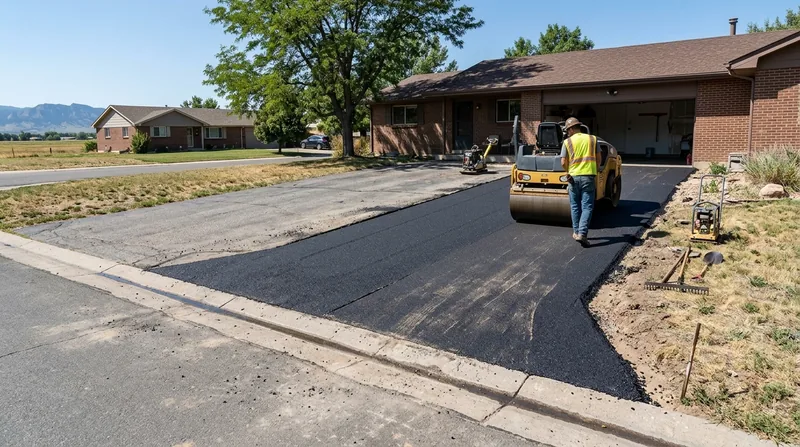




Fort Collins homeowners and property managers often face a straightforward challenge: the driveway is too narrow for a second or third vehicle, the garage apron has settled or cracked, or there is no room for an RV or trailer without overhang onto the street or lawn. Driveway extensions, widening and aprons in Fort Collins solve that problem by adding paved surface where it is needed most, tying seamlessly into your existing asphalt and built to the same compaction and thickness standards as a full new drive. From the Victorian bungalows on narrow Old Town lots to the two and three-car subdivisions south and east of the city where driveways are aging together, the demand for parking pad additions and apron rebuilds runs steady year-round. We add parking pads for the third car or the trailer, widen tight drives that were built for single-car era homes, and rebuild broken or settled garage aprons where freeze-thaw cycles and clay-soil heave have done their damage. Every extension is milled seamless into your existing asphalt so there is no lip, no trip hazard, and no weak joint where water pools and fails first.
Why Driveway Extensions and Widening Matter in Fort Collins
The Front Range climate and the way Fort Collins has grown create a perfect storm for tight driveways and failing aprons. The 1960s and 1970s ranches on the north side and midtown were built with single-car asphalt drives that are now 50 to 60 years old, their surfaces oxidized gray by high-altitude sun and their bases weakened by decades of freeze-thaw cycles. The bigger subdivisions from the 1990s and 2000s in south and southeast Fort Collins, Loveland, and Windsor added two and three-car driveways, but many homeowners have since added a second or third vehicle, a trailer, or an RV that simply will not fit. The expansive clay soils common across Weld County swell and heave under slabs and aprons in winter, leaving settled or cracked aprons that become trip hazards and water traps. An extension or apron rebuild is often the fastest and most cost-effective way to add functional parking without a garage renovation.
- Add a dedicated pad for a third car, trailer, or RV without encroaching on the street or landscaping.
- Widen a drive that is too narrow for two vehicles to pass safely or for a modern SUV to fit comfortably.
- Rebuild a settled or cracked garage apron that has become a trip hazard and a water collection point.
- Create a seamless joint between new and existing asphalt using milling and proper bonding so water does not infiltrate at the seam.
- Meet municipal and HOA parking or impervious-surface standards without a full driveway replacement.
Extensions and apron work are small-footprint jobs, but they carry the same compaction and base-prep rigor as a full drive so they perform for 15 to 20 years without premature failure.
Key info: Fort Collins and most Front Range municipalities require a permit for driveway aprons, curb cuts, and extensions because they affect stormwater runoff and the right-of-way. Verify with your city or HOA before you start. See the Fort Collins Development Services website for permit requirements and impervious-surface limits.
How We Build Driveway Extensions and Widenings in Fort Collins
Every extension and widening starts with a site visit to measure the area, check the existing asphalt condition, and identify the best way to tie in the new surface. We locate utilities using Colorado 811 so we do not strike a line during excavation. We then excavate and grade the extension area, compact the subgrade, lay and compact a base course (crushed stone), mill a small pocket into the edge of your existing asphalt, and pave the new section with hot mix asphalt at the same thickness and density as your original drive. The milled seam creates a mechanical bond that holds water out and keeps the two sections from separating. Compaction is verified by proof rolling, and we finish with proper edge details and drainage so water sheds away from the foundation and the apron.
- Schedule a free on-site estimate and we measure the extension area, check soil and grade, and identify utilities.
- Verify permits and HOA architectural standards with your city or master-planned community before we schedule the work.
- We locate all underground utilities using Colorado 811 and mark them so excavation is safe.
- Excavate, grade, and compact the subgrade to remove soft soil and create a stable foundation for the base course.
- Lay and compact crushed stone base at the proper thickness and density, then proof-roll to verify bearing.
- Mill a shallow pocket into the edge of your existing asphalt and apply a tack coat so the new asphalt bonds mechanically to the old.
- Pave the extension with hot mix asphalt at the same thickness as your existing drive, typically 2 inches for residential work.
- Compact the new asphalt with a vibratory roller and finish edges and details so water drains away from structures.
The whole process typically takes one to three days depending on the size of the extension and the weather. New asphalt must cure for 24 to 48 hours before driving on it in cool weather, longer if it is hot.
Example: A Windsor homeowner needed to widen her two-car drive by 6 feet to park a third vehicle safely. We excavated 480 square feet, laid 4 inches of base, milled the edge of the existing drive, and paved 2 inches of hot mix. The milled seam tied the new asphalt to the old so there was no lip and no water trap. Total time was two days, and the cost started at $2,400. The extension will perform alongside the existing drive for 15 to 20 years if it is maintained.
Extension and Widening Methods
| Approach | Description | Best for |
|---|---|---|
| Milled seam extension | Mill a shallow pocket into the edge of existing asphalt, apply tack coat, and pave new asphalt so it bonds mechanically and does not separate or collect water. | Most residential extensions and widenings where the existing drive is in fair to good condition and the new section is less than 1,000 sq ft. |
| Full-depth extension with base rebuild | Excavate the extension area to subgrade, compact and build a new base course, mill the seam, and pave the new section at full thickness. | Extensions where the subgrade is soft, wet, or heaved, or where proper drainage and bearing require base reconstruction. |
| Apron replacement | Remove and replace a settled or cracked garage apron, rebuild the base, and pave a new apron with proper slope and drainage. | Broken aprons where the existing surface is cracked, settled, or heaved and poses a trip hazard or water collection. |
| RV or trailer pad | Grade and pave a dedicated pad, typically 12 by 35 feet or larger, with proper base, slope, and seamless tie-in to the existing drive. | Homeowners with an RV, boat, or utility trailer who need a stable, level pad that does not damage the lawn or encroach on the street. |
Driveway Extensions, Widening and Aprons Cost in Fort Collins: What to Expect
The cost of a driveway extension or widening depends on the size of the new surface, the condition of the existing asphalt and the subgrade, site access, and whether permits are required. A small extension of 200 to 300 square feet with good subgrade and a straightforward milled seam starts at around $1,800 to $2,200. Larger widenings of 500 to 800 square feet, especially those that require base reconstruction or apron replacement, run $2,800 to $4,500. RV or trailer pads of 12 by 35 feet (420 square feet) typically start at $2,500 to $3,200 depending on base condition and site drainage. An on-site estimate is free and includes a measurement of the area, a review of the existing drive and subgrade, a discussion of permits and HOA requirements, and a written estimate with tonnage and thickness specifications. See our pricing page for a full breakdown of extension and widening costs and the factors that move them up or down.
Factors that affect cost include the size of the extension in square feet, the condition and thickness of your existing asphalt, whether the subgrade is stable or requires base reconstruction, site access for equipment, whether utilities require relocation or careful hand-excavation, local permit and inspection fees, and whether the extension is a simple milled seam or a full-depth replacement with new base and drainage. Getting two or three estimates from local contractors is smart because methods, base thickness, and compaction standards vary, and a written estimate should always include square footage, asphalt thickness, base course thickness, and tonnage so you can compare apples to apples.
Cost example: A Loveland homeowner added a 400-square-foot pad for a second vehicle next to an existing two-car drive. The subgrade was stable, and a simple milled seam with 2 inches of new asphalt was sufficient. The total cost was $2,650. By contrast, a Fort Collins homeowner with an RV pad project required full-depth excavation, 4 inches of base, and 2.5 inches of asphalt on soft clay soil. That project was 500 square feet and cost $3,800. Always get a written estimate with thickness and tonnage so you know what you are paying for.
Driveway Extensions, Widening and Aprons Near Me: What to Look for When Hiring a Paving Contractor in Fort Collins
Choosing a contractor for a driveway extension or apron job is straightforward if you know what to ask. A good contractor is local, holds current insurance, can show you examples of past work in your area, understands local permitting and HOA rules, and gives you a written estimate with measurements, thickness specs, and tonnage. Avoid any contractor who shows up unsolicited at your door, offers a price without a site visit, asks for a large cash deposit before starting, or quotes a price per square foot without knowing the subgrade condition or base requirements. Paving is quoted on site because soil, existing asphalt condition, and drainage vary from property to property. Ask for references from homeowners in Fort Collins, Loveland, or Windsor, and verify that the contractor is fully insured and can show proof of coverage. If your extension touches the street or the right-of-way, or if you live in an HOA, confirm that permits and architectural approvals are in place before work begins. Call us at (970) 825-0876 for a free estimate and we will walk you through the process, verify local requirements, and give you a clear written price.
- Get a free, no-obligation on-site estimate from a local contractor who measures the area and reviews the existing asphalt and subgrade.
- Ask for a written estimate that includes square footage, asphalt thickness, base course depth, and tonnage so you can compare bids fairly.
- Verify that the contractor is fully insured and can provide a current certificate of insurance naming you as additional insured.
- Confirm that all required permits have been obtained or will be obtained before work starts, especially for aprons and extensions near the street.
- Check references from recent projects in Fort Collins or nearby communities and ask about compaction, drainage, and how the extension performed in the first winter.
- If you live in a master-planned community, verify HOA architectural approval before you hire anyone so the extension meets material and design standards.
A driveway extension or apron is a small project, but it is visible every day and affects how water drains from your property. Hiring a local contractor who understands Fort Collins soil, climate, and permitting is the best way to ensure the work is done right the first time. Call us today for your free estimate.
Driveway Extensions, Widening & Aprons in Fort Collins: Pricing Guide
| Service | Price | Details |
|---|---|---|
| Small extension (200-300 sq ft) | Starting at $1,800 | Milled seam, stable subgrade, 2 inches of asphalt, no base reconstruction needed |
| Medium widening (400-600 sq ft) | Starting at $2,400 | Milled seam or full-depth section, base course included, proper drainage and compaction |
| Large extension or apron (700-1,000 sq ft) | Starting at $3,200 | Full-depth excavation, base rebuild, soft soil or clay heave, proper slope and drainage |
| RV or trailer pad (12 by 35 feet or custom) | Starting at $2,500 | Dedicated pad, full base, level surface, seamless tie-in to existing drive |
| Apron replacement (settled or cracked) | On estimate | Depends on existing condition, subgrade stability, and whether full excavation or overlay is appropriate |
| Estimate and site visit | Free | Response within 24 hours, measurements and soil review included, no obligation to book |
Indicative pricing, the exact cost depends on square footage, finish, and site access. Free personalized estimate within 24h at (970) 825-0876.


